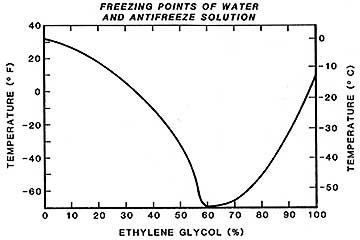
The system is filled with a mixture of coolant and water. Coolant is present to lower the freezing point, raise the boiling point, and provide corrosion protection. Too little coolant won't provide enough corrosion protection and too much will actually start to raise the freezing point. This is the reason manufacturer give maximum percentages on the mixture ratio. You can read a quantitative article on this by the Alaska Science Forum that shows the following relation:
Now we have to choose which coolant and which water to add. I always like to stick with the stock Toyota Red coolant. But if you want to change be careful not to mix them, because the mixture can get very corrosive for your coolant system. A good article, Antifreeze: Red or Green?, is a recommended read before you make any decisions. But as for the water choice, always use distilled. It won't leave scale in your coolant system and it won't react with the Antifreeze. I did a test by putting some coolant in a glass with tap water and one with distilled water. The next morning the distilled water was nice and pink and clear, but the tap water one had a noticeable collection of fine white particles that precipitated out on the bottom.
Now that you have chosen your ingredients you need to chose the proportions. You need a minimum of 25% coolant to provide proper corrosion protection. So to maximize the cooling efficiency you should keep the minimal percentage of coolant over 25% that will still work in your environment. I live in Southern California so cold temperatures are not a concern for me. But if they are for you consult the above chart when making your decision, and remember you can always have a summer mixture, and a winter mixture. My mixture is:
- 30% Toyota Red
- 70% Distilled Water
- 12oz Red Line Water Wetter
I tested this in my own home, at sea level, and I got -6.2F freezing and for boiling I got 220F. Now, if you read this far without falling asleep, you are ready to begin.
| Tools: |  |
12mm socket wrench |
| Flat head screw driver | ||
| Collection Pan | ||
| Funnel | ||
| Measuring Cup | ||
| Materials: | 1 Gallon Toyota Red | |
| 3 Gallons distilled water per flush cycle | ||
| 12oz Red Line Water Wetter |
While you are here
| 1. | Check your coolant hoses for age and replace as needed. |
| 2. | Replace the thermostat. |
Instructions
| 1. | Starting with a cold car and remove the radiator cap. |
| 2. | Remove the body undercover using the 12mm socket wrench (optional but makes collecting the coolant easier.) |
| 3. | Open the drain-cock on the bottom drivers-side of the radiator and let all the coolant drain out. This takes like 10 minutes, and watch that your container doesn't overflow. |
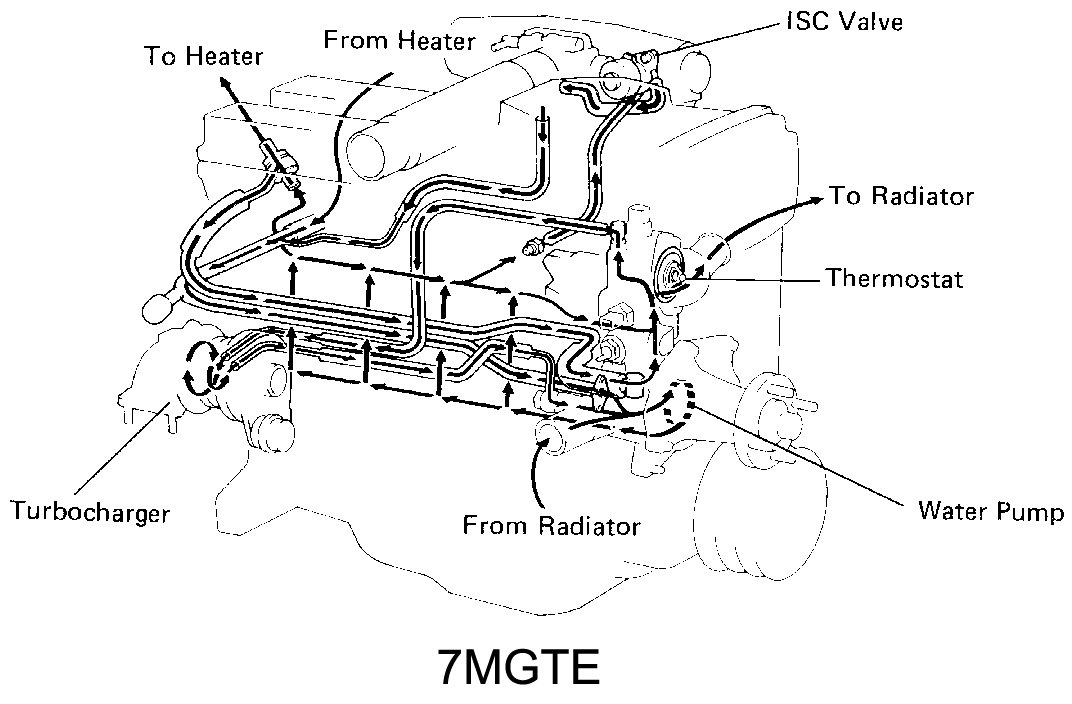
| 4. | Using the flat head screw driver remove the heater hose from that comes from the back of the head to the right side of the heater junction at the heater junction connection. This is the hose that comes from the back of the head and is over a foot long and travels along the side of the firewall. You can see it in this diagram as part number 87245A. |
| 5. | Place the funnel in the hose and pour 1 gallon of distilled water into it to flush the coolant out of the block and head. |
| 6. | Empty the overflow container. |
| 7. | Reconnect the heater hose and close the drain-cock at the bottom of the radiator. |
| 8. | Fill the radiator with distilled water, replace cap and fill overflow reservoir There will be air in the system so after it sits over night or you drive it around you should check the level in the radiator. Mine is self-correcting but if yours isn't read the SOGI article on purging the air. |
| 9. | After driving around a day or two with the distilled water in the system repeat as many times until it is as clear as you like. I usually do 3 times. Then when you are ready to put the coolant mixture after step 7 pour in a bottle of Red Line Water Wetter then the proper amount of coolant. The whole system holds about 8.1 liters (8.5qt) so 30% mixture is 10.2 cups. Finally add distilled water to the top and fill up the overflow bottle. Then do your normally driving and checking the level until all the air is out. |